
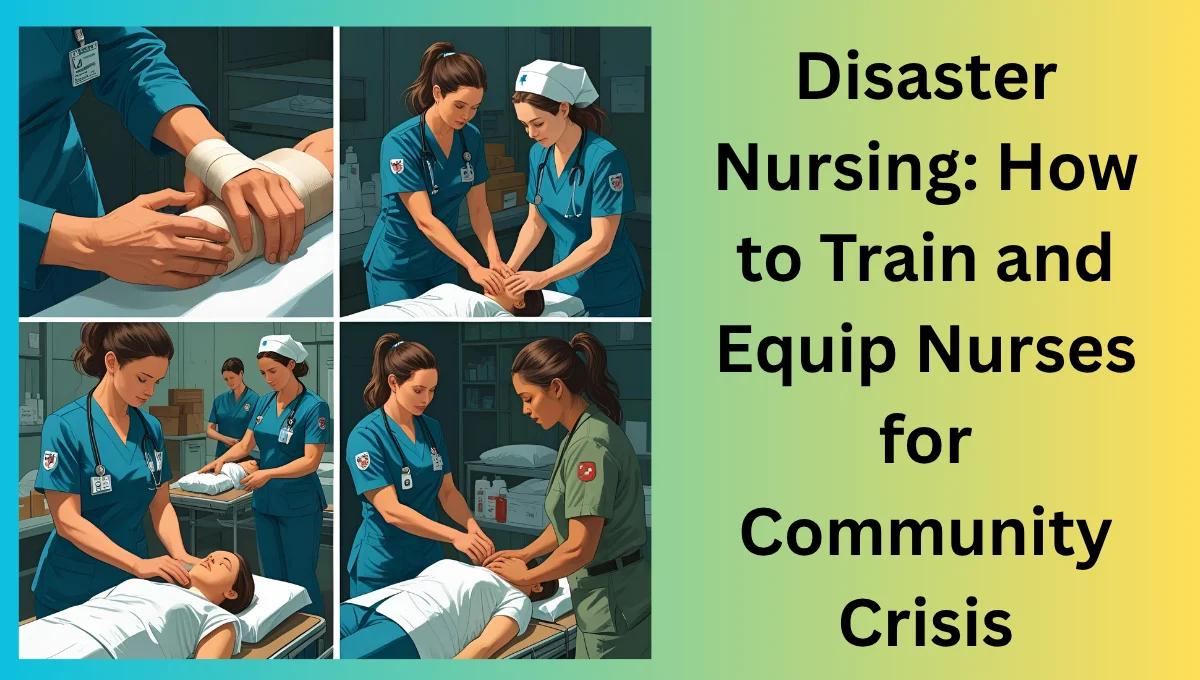
Disaster Nursing: How to Train and Equip Nurses for Community Crisis
✅ Introduction
In a world increasingly impacted by natural disasters, pandemics, and humanitarian crises, nurses serve as the foundation of crisis response. In the event of an earthquake, flood, disease, or industrial tragedy, skilled nurses act as first responders, providing life-saving care and stabilizing populations. This article examines the training and preparation of nurses for community disasters, detailing the requisite skills, tools, and systems necessary for proficient disaster nursing.

What constitutes disaster nursing?
Disaster nursing pertains to the specific domain of nursing focused on the preparation, response, and recovery from catastrophes and emergencies. Nurses in this domain are equipped to provide care under intense pressure, frequently in resource-limited settings.
They perform essential functions in:
Emergency assessment and intervention
Health education and illness prevention
Psychological First Aid
Collaborating with emergency services and non-governmental organizations
Surveillance of at-risk groups
🔧 Essential Elements of Disaster Nursing Training To adequately address a crisis, nurses require competencies that extend beyond fundamental clinical abilities. Specialized training and simulations are necessary.
- Disaster Preparedness Education Incorporate disaster nursing modules into nursing curricula. Address subjects such as disaster classifications, mass casualty events, infection management, and crisis communication. Offer both online and offline continuing education for registered nurses (RNs). Simulation-Driven Training
Implement realistic drills to equip nurses for triage, patient transport, and treatment in austere settings. Integrate tabletop exercises and role-playing for many crisis situations, including floods, fires, and epidemics. Promote interdisciplinary exercises including paramedics, fire services, and civil defense units. - Incident Command System (ICS) nurses must comprehend their position within the emergency command hierarchy. Acquire skills in communication, reporting, and action within disaster coordinating frameworks at both local and national tiers.
- Triage and Expedited Evaluation Competencies
Instruct nurses to classify and prioritize patients according to urgency. Implement methodologies such as the START (Simple Triage and Rapid Treatment) approach. Highlight ethical decision-making in high-pressure situations. - Preparing Nurses for Community Disaster Response
Training alone is insufficient; nurses must be adequately prepared both physically and digitally to manage real-life crisis situations. - Emergency Response Kits
Nurses ought to possess access to first aid supplies. Personal Protective Equipment (gloves, masks, goggles) Medications for emergencies Illuminators, communication devices, portable power sources Water purification and sanitation products - Mobile Health Instruments
Provide nurses with portable diagnostic instruments. Employ telehealth platforms for remote triage. Utilize mobile applications for reporting, coordination, and patient monitoring. - Logistics of Transportation and Shelter
Empower nurses to establish and manage emergency shelters, field clinics, and vaccination sites. Supply instruments for overseeing crowd management and infection mitigation in confined areas. - Community Involvement and Leadership
Disaster nursing extends beyond the confines of the hospital. Empowering nurses to include communities prior to, during, and subsequent to disasters facilitates expedited recovery and reduces casualties. - Community roles encompass conducting disaster education workshops. Educating community volunteers and healthcare practitioners Identifying vulnerable populations (elderly, disabled individuals, children) Engaging in local emergency planning committees
- Leadership Competencies: Crisis Communication Ethical decision-making in the context of resource limitations Delegation and cooperation in high-pressure settings
- Mental Health and Resilience in Catastrophes Nursing catastrophes impose a psychological burden on both victims and responders. Nurses require resources to enhance emotional resilience and mental well-being.
- Psychological First Aid (PFA) training for nurses’ mental health support Collegial assistance frameworks Access to counseling following tragic occurrences Techniques for managing stress, such as mindfulness and debriefing
- 📈 Tangible Outcomes: Nurse-Led Disaster Success Narratives Case Study 1: Typhoon Haiyan, Philippines (2013)
Nurses delivered primary care, established mobile clinics, and oversaw sanitation initiatives, markedly decreasing post-disaster infections. - Case Study 2: Response to the COVID-19 Pandemic
Community nurses conducted testing initiatives, provided home-based care, performed contact tracing, and ensured continuity of care in remote and underserved areas. - Conclusion
Preparing and training nurses for community crisis response encompasses not just readiness but also resilience, leadership, and life-saving intervention. When empowered, nurses can significantly mitigate crisis effects, safeguard public health, and reinstate routine. Governments, organizations, and communities must prioritize investment in disaster nursing education and preparedness to ensure a safer future. - Frequently Asked Questions (FAQs):
- What is disaster nursing?
Disaster nursing encompasses the provision of care during and subsequent to a disaster, including triage, emergency intervention, and public health administration. - What is the significance of simulation training for nurses?
Simulation replicates authentic emergency events, enabling nurses to hone skills such as triage, collaboration, and resource management in a secure setting. - What items should a nurse’s disaster kit contain?
Essential medical supplies, personal protective equipment, a flashlight, emergency contact details, prescriptions, and sanitation instruments. - Can community nurses spearhead disaster preparedness initiatives?
Affirmative. Community nurses can instruct local volunteers, evaluate vulnerabilities, and assist in formulating emergency response strategies. - How can nurses safeguard their mental well-being during crises?
Utilizing methods such as psychological first aid, debriefing sessions, and obtaining peer or professional therapy support.