
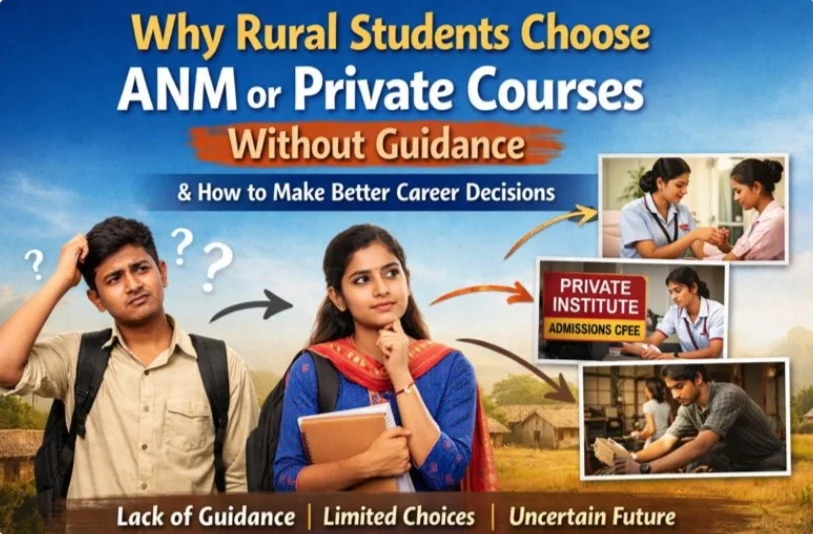
Meta Description
Why do rural students choose ANM or private courses without guidance? Learn the real reasons, common mistakes, and smart career solutions to build a better future after 10th or 12th.
Introduction: A Silent Career Crisis in Rural India
Every year, thousands of students from rural and village areas complete 10th or 12th standard with hope in their eyes — but confusion in their minds.
They ask the same questions:
“What should I do next?”
“Which course will give me a job?”
“Who will guide me?”
Sadly, for many rural students, there is no clear answer.Due to lack of career guidance, limited exposure, financial pressure, and social influence, many students end up choosing ANM (Auxiliary Nurse Midwife) or private courses without fully understanding:
career scope
job reality
salary expectations
future growth options
This article explores why this happens, what mistakes are commonly made, and most importantly — how rural students can make smarter, informed career decisions that truly help them grow in life.
Understanding the Rural Education Reality
Before blaming students for “wrong choices,” we must understand their environment.
Life in Rural and Semi-Rural Areas
Many village students grow up with:
1. Limited access to career counselor
2. Schools focused only on syllabus completion
3. Teachers overloaded with administrative work
4. Parents unfamiliar with higher education pathways
Unlike urban students, rural students rarely get:
1.Career seminars
2. Exposure to multiple professions
3. Internet-based guidance (or proper digital literacy)
As a result, career decisions are often rushed, emotional, or influenced by others.

Why Do Rural Students Choose ANM or Private Courses Without Guidance?
- Lack of Career Awareness After 10th or 12th
Most rural students know only a few career options:
Doctor
Nurse
Teacher
Police
Army
Among these, ANM appears as the “easiest and fastest” option, especially for girls.
Students are often unaware of:
GNM vs ANM vs BSc Nursing differences
Paramedical alternatives
Allied health courses
Skill-based diploma programs
Government college admission pathways
When choices are limited, decisions become default, not deliberate.
2. No Access to Professional Career GuidanceIn many villages:
Career counselors don’t exist
Schools don’t offer counseling sessions
Parents rely on neighbors’ advice
So guidance comes from:
Relatives
Local agents
Private institute marketing staff
Unfortunately, these sources often have vested interests, not the student’s long-term growth in mind.
- Fear of Entrance Exams and Competition
Many students believe:
“NEET is impossible”
“Government seats are only for toppers”
“English medium courses are too difficult”
This fear pushes them toward private institutes that promise:
“No entrance exam”
“Guaranteed admission”
“Job assurance”
Without understanding the reality, students accept these promises blindly.
4. Financial Pressure and Early Earning Needs
For many rural families:
Education is expensive
Income is limited
Students are expected to earn early
ANM and private diploma courses appear attractive because:
Short duration
Lower eligibility criteria
Faster job possibility
But short-term thinking often leads to long-term struggle.
5. Gender Bias and Social Conditioning
Girls are often told:
“Nursing is safe for girls”
“ANM job is suitable after marriage”
“You can work near home”
Boys are told:
“Private technical course will give quick job”
These stereotypes limit potential and push students into roles without exploring better options.
6. Aggressive Marketing by Private Institutes
Private colleges and coaching centers actively target rural areas by:
Visiting villages
Distributing pamphlets
Offering installment fees
Promising placement
Their focus is admission numbers, not student futures.Students rarely check:
Institute recognition
Course validity
Job placement truth
Alumni success

Common Mistakes Rural Students Make While Choosing Courses
Choosing Course Based Only on “Easy Admission”
Easy admission does not mean easy career.
Ignoring Long-Term Career Growth
Many students don’t ask:
What after ANM?
Promotion options?
Salary growth?
Not Verifying Course Recognition
Some private courses are:
Not government-recognized
Not accepted abroad
Limited to few hospitals
Copying Others’ Choices
“If my cousin did ANM, I will also do it” — this mindset ignores individual interest and ability.

Reality Check: ANM and Private Courses – Pros and Cons
When ANM Can Be a Good Choice
ANM can be useful if:
Student understands limitations
Plans for future upgrades (GNM, BSc Nursing)
Gets government posting
Has genuine interest in community health
Limitations of ANM
Limited promotion
Lower salary ceiling
Fewer hospital roles
Often contractual jobs
Private Courses: Not Always Bad, But Risky
Private courses are acceptable only if:
Institute is recognized
Course has real demand
Student has verified job scope
Impact of Wrong Career Decisions on Rural Students’ Lives
Poorly informed decisions can lead to:
Job dissatisfaction
Financial stress
Repeated course changes
Low self-confidence
Wasted years and money
Many students later say:“If someone had guided me properly, my life would be different.”

How Rural Students Can Make Better Career Decisions
- Start Career Thinking Early (8th–10th Standard)
Career awareness should begin before 10th, not after results.
Students should explore:
Interests
Strengths
Academic ability
Practical skills - Learn About All Available Career Options
Students must understand:
Medical vs paramedical courses
Nursing pathways (ANM → GNM → BSc)
Allied health professions
Skill-based diplomas
Government vs private colleges
Knowledge expands choices — choices improve decisions. - Use Free and Trusted Online Resources
Today, even rural students can access:
Government education portals
YouTube career guidance channels
Official nursing council websites
Online webinars and workshops
Digital awareness is a powerful equalizer. - Verify Course and Institute Before Admission
Before joining any course, students must check:
Is the institute recognized?
Is the course approved by council?
What are alumni doing now?
Are job claims real?
Never depend only on marketing words. - Seek Multiple Opinions — Not Just One
Talk to:
Working professionals
Senior students
Government teachers
Career counselors
Multiple perspectives reduce mistakes. - Parents Must Be Educated Too
Parents often decide out of fear, not facts.
They must learn:
Education is an investment
Quality matters more than speed
Guidance prevents future regret - Think Long-Term, Not Just First Job
Ask:
Where will I be in 5–10 years?
Can I upgrade this course?
Will this career support my family long-term?
Role of Schools, Colleges, and Government
Schools Should:
Introduce career guidance sessions
Invite professionals for talks
Encourage aptitude-based choices
Colleges Should:
Provide honest counseling
Stop false promises
Support career planning
Government Should:
Strengthen rural career counseling
Regulate private institutes
Promote awareness campaigns
Real Success Begins With Right Guidance
When rural students receive:
Correct information
Honest guidance
Emotional support
They don’t settle for “any course.”
They choose the right course.
Education should not be about escaping poverty quickly, but about building a stable, respected life.
Conclusion:
From Confusion to Confidence
Rural students are not less talented — they are less informed.
Choosing ANM or private courses without guidance is not a failure of students, but a failure of the system.
With proper awareness, counseling, and support:
Rural students can dream bigger
Choose smarter careers
Build meaningful futures
The right guidance at the right time can change not just a career, but an entire generation.
Frequently Asked Questions
Is ANM a bad career choice?
No, but it has limitations. It should be chosen with full awareness and future planning.
Why do rural students avoid government colleges?
Due to fear of competition, lack of guidance, and misinformation.
Can private courses lead to good jobs?
Only if the course and institute are recognized and in demand.
How can rural students get career guidance?
Through schools, online platforms, NGOs, educators, and trusted profession