
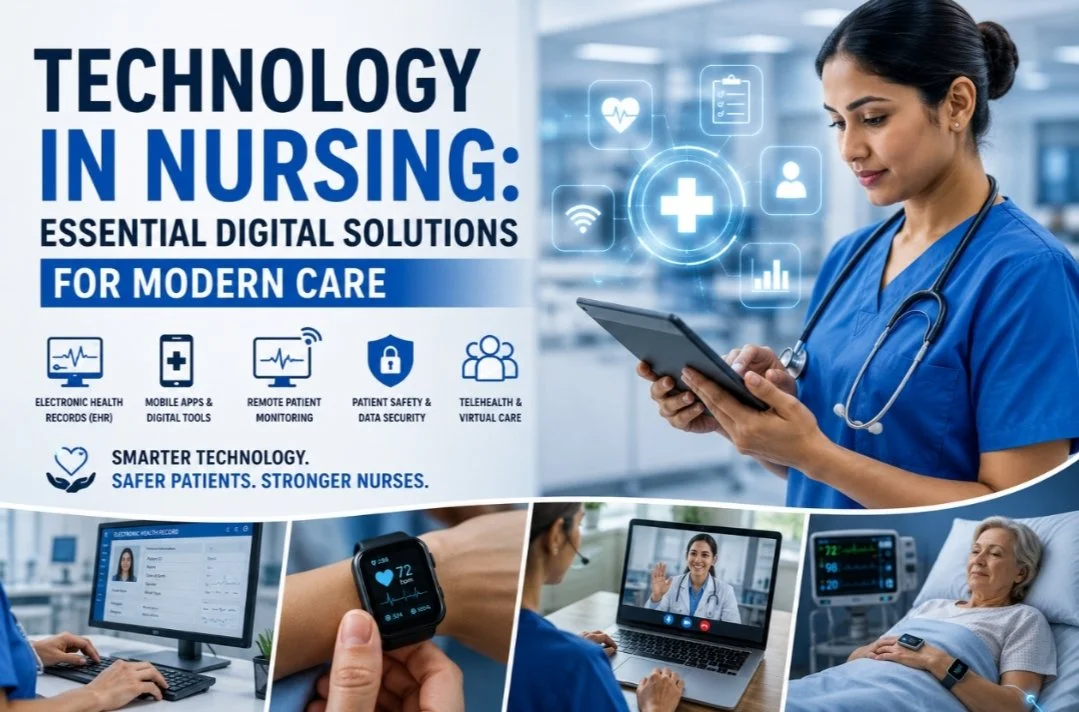
Technology in Nursing: Essential Digital Solutions for Modern Care

Meta Description:
Explore how technology in nursing is transforming modern patient care. From EHR and telehealth to AI, smart pumps, and nursing apps — your complete guide to essential digital solutions in nursing practice.
There is a moment that many experienced nurses remember vividly the shift when paper charts disappeared and a glowing screen took their place. Some felt excitement. Others felt anxiety. Most felt both.
That moment, for many healthcare facilities, was the beginning of something much larger than a new documentation system. It was the beginning of a fundamental reimagining of what nursing practice looks like in the modern world.
Today, technology is woven into nearly every aspect of nursing care. From the smart pump beeping at the bedside to the telehealth platform connecting a nurse with a patient hundreds of miles away, digital solutions are reshaping how nurses assess, communicate, medicate, document, and advocate for the people in their care.
This is not a story about technology replacing nurses. It never will be. It is a story about how the right digital tools, in the hands of skilled and compassionate nurses, can make patient care safer, faster, and more effective than ever before.
Whether you are a nursing student just beginning your clinical journey, a practicing nurse navigating a new hospital system, or a healthcare leader evaluating digital investments,
this guide will walk you through the most important technologies shaping modern nursing — and what they mean for the future of the profession.

The Digital Transformation of Healthcare: Why Now?
Healthcare has always evolved. But the speed of change in the past decade has been extraordinary.
Several forces have converged to accelerate the adoption of digital technology in nursing and healthcare more broadly. Patient populations are aging and living longer with complex, chronic conditions that require sustained monitoring and management. Healthcare systems face growing pressure to deliver more care with limited resources. The global COVID-19 pandemic exposed critical gaps in how care was delivered — and forced rapid adoption of digital solutions, particularly telehealth, almost overnight.
At the same time, the technology itself has become more sophisticated, more intuitive, and more integrated. Systems that once operated in isolation now communicate with each other. Data that once lived in separate silos — pharmacy records, nursing notes, laboratory results, imaging reports — now flows together in real time, giving every member of the care team a complete and current picture of every patient.
For nurses, who spend more direct time with patients than any other healthcare professional, this shift has both enormous potential and real challenges. Understanding the technology available — and how to use it safely and effectively — has become as important as any clinical competency.
Electronic Health Records: More Than Just Digital Paperwork
Ask any nurse who trained in the era of paper charts what they remember most, and the answer is usually the same: the searching. Hunting through filing cabinets for a patient’s previous admission notes. Waiting for a chart to come back from radiology. Rewriting the same information in three different places because three different departments needed their own copy.
Electronic Health Records eliminated most of that. And in doing so, they changed nursing practice in ways that go far deeper than documentation convenience.
An EHR is a living digital record of everything clinically relevant about a patient — their diagnosis, their medications, their allergies, their vital sign trends, their laboratory results, their imaging reports, their care plans, and the nursing notes that document every assessment and intervention. That record is accessible to every authorized member of the care team, simultaneously, from any connected terminal in the facility.
For nurses, this means that when a patient is transferred from the emergency department to a surgical ward at two in the morning, the receiving nurse does not start from scratch. The complete clinical picture — including every nursing note written during the ED stay — is already there, waiting.
EHR systems also build safety nets directly into the documentation process. Automated alerts flag potential medication interactions. Incomplete assessment fields prompt nurses before a chart can be finalized. Vital sign trends are displayed graphically, making deterioration visible in a way that individual readings never could.
The honest reality is that EHR systems are not universally loved by nurses, and the reasons for that deserve acknowledgment. Poorly designed systems can increase documentation time, contribute to screen fatigue, and pull nurses away from the bedside. System downtime — though infrequent — can be genuinely disruptive. These are real problems that healthcare organizations and technology developers are actively working to address.
But the clinical case for electronic health records is strong. When implemented thoughtfully, with adequate training and ongoing support, EHR systems make patient care safer and clinical communication more reliable than any paper-based system could.

Telehealth: Bringing the Nurse to the Patient
Before telehealth became mainstream, a patient living in a rural community with limited transport and a chronic heart condition faced a difficult choice at every health concern: make the long journey to the nearest clinic, go without care, or call an emergency service.
Telehealth changed that equation completely.
Through video consultations, telephone assessments, and remote monitoring platforms, nurses can now deliver high-quality clinical care to patients wherever they are. A patient recovering from surgery at home can have their wound assessed via video. A patient with poorly controlled diabetes can have a medication review and education session with their diabetes nurse specialist without leaving the house. An elderly patient with multiple chronic conditions can have regular check-in calls that catch problems early, before they become emergencies.
The clinical benefits of telehealth extend beyond convenience. For patients managing long-term conditions, regular virtual contact with a healthcare professional improves adherence to treatment plans, catches deterioration earlier, and builds the kind of therapeutic relationship that supports better health outcomes over time.
Telehealth also plays a critical role in reducing unnecessary hospital admissions and emergency department attendances.
For nurses practicing in telehealth settings, the core clinical skills remain exactly the same: thorough assessment, clear communication, empathetic listening, patient education, and clinical decision-making. What changes is the medium — and the need to develop specific skills in conducting effective virtual consultations, including techniques for assessing patients without physical examination and building rapport through a screen.
Telehealth is not a lesser form of nursing care. In many contexts, it is an essential one

Mobile Nursing Apps: A Clinical Library That Fits in Your Pocket
Not long ago, nurses carried small paper drug guides in their pockets — spiral-bound books with tiny print that were outdated almost as soon as they were printed. Today, those same nurses carry smartphones loaded with applications that provide instant access to medication databases updated in real time, evidence-based clinical guidelines, drug interaction checkers, dosage calculators, and diagnostic decision support tools.
The breadth of clinical functionality now available through nursing apps is genuinely impressive.Medication reference apps provide complete prescribing information for thousands of drugs, including dosing ranges, contraindications, interactions, administration guidelines, and patient counseling points. Drug calculation apps eliminate manual arithmetic from medication preparation, reducing calculation errors particularly in high-stakes settings like intensive care and pediatrics. ECG interpretation apps help nurses identify cardiac rhythms quickly and with confidence. Clinical scoring apps — for sepsis screening, pain assessment, fall risk, and dozens of other tools — make evidence-based assessment more consistent and efficient.
Beyond direct clinical support, mobile apps have transformed how nurses access and complete continuing professional education. Online learning platforms, webinar access, simulation exercises, and professional certification programs are all available through mobile devices, allowing nurses to maintain and develop their clinical competence around the demands of shift work and family life.
The important caveat is quality. Not every healthcare app is created equal, and nurses have a professional responsibility to evaluate the apps they use clinically. A good clinical app should be developed with input from healthcare professionals, reference evidence-based sources, be updated regularly, and — where relevant — be approved by the employing organization.
Used critically and responsibly, mobile apps are one of the most practical and accessible ways that technology has improved day-to-day nursing practice.
Smart Infusion Pumps and Barcode Medication Administration
Medication errors remain one of the most significant sources of preventable harm in healthcare settings. Two technologies — smart infusion pumps and barcode medication administration systems — have made a measurable difference in reducing that harm.
Smart infusion pumps do more than deliver intravenous fluids and medications. They are programmed with drug libraries containing safe dosing parameters for hundreds of medications. When a nurse programs an infusion dose that falls outside the established safety limits — whether because of a calculation error, a misread prescription, or a distraction during setup — the pump generates an alert before delivery begins.
This matters most for the medications that carry the greatest risk: insulin, anticoagulants, opioids, vasopressors, and chemotherapy agents. These are medications where even small dosing errors can cause catastrophic harm. A smart pump alert does not override clinical judgment — it supports it, providing a second verification at the most critical moment.
Barcode Medication Administration, widely known as BCMA, adds another layer of safety at the point of medication delivery. Before administering any medication, the nurse scans the patient’s wristband barcode and the medication barcode. The system cross-checks this against the patient’s current medication orders and verifies that the right patient is receiving the right drug at the right dose at the right time.
If anything does not match — if the nurse has inadvertently picked up the wrong medication, or if the medication has already been given during that administration window — the system alerts immediately. Research consistently shows that BCMA systems significantly reduce medication administration errors in settings where they are used consistently and correctly.
Together, smart pumps and BCMA represent technology functioning at its best in healthcare: quietly, reliably building safety into the workflow without adding burden to the nurse.

Wearable Technology and Continuous Patient Monitoring
Clinical deterioration rarely announces itself loudly. More often, it arrives through gradual, subtle changes — a heart rate that creeps upward through the shift, an oxygen saturation that drifts slightly downward, a respiratory rate that is marginally elevated across several consecutive readings. In a traditional nursing model, these changes might be missed between scheduled vital sign observations.
Continuous monitoring technology changes that dynamic fundamentally.
Wearable monitoring devices can track heart rate, oxygen saturation, respiratory rate, blood pressure trends, and other physiological parameters in real time, transmitting data continuously to central monitoring platforms visible at the nurses’ station. Rather than capturing a snapshot every four hours, nurses now have access to an ongoing physiological story — one that makes deterioration patterns visible long before they would become apparent through scheduled assessments alone.
For patients with diabetes, continuous glucose monitoring has transformed management, providing a constant stream of glucose data and trend arrows that allow nurses and patients to respond to changing glucose levels proactively rather than reactively.
Wearable technology is also expanding the reach of clinical monitoring beyond hospital walls. Patients in community nursing programs, residential care facilities, and home care settings can be monitored remotely through wearable devices that transmit data to nursing teams in real time — enabling early intervention and reducing the need for hospital readmission.
One important challenge associated with continuous monitoring is alarm fatigue. When monitoring systems generate too many alerts — particularly false alarms or low-priority notifications — nurses can become desensitized to them, with the risk that a genuine critical alert is missed. Modern monitoring platforms are addressing this through intelligent alarm filtering, escalation protocols, and integration with nursing workflow systems that route alerts to the right nurse at the right time.
Artificial Intelligence: A Powerful Tool in Nursing’s Hands
Artificial intelligence in healthcare has moved well beyond theoretical possibility into active clinical deployment, and its presence in nursing practice is growing steadily.
AI-powered clinical surveillance systems analyze continuous streams of patient data — vital signs, laboratory trends, medication histories, and nursing documentation — and identify patterns associated with clinical deterioration or specific diagnoses. Sepsis prediction algorithms, for example, can identify patients showing early biochemical and physiological warning signs of sepsis hours before the condition becomes clinically evident, giving care teams a critical window for early treatment that significantly improves outcomes.
Predictive analytics tools built into EHR systems can flag patients at elevated risk of falls, pressure injuries, or unplanned hospital readmission — allowing nurses to direct preventive interventions toward the patients who need them most, rather than applying standard protocols uniformly to everyone.
AI is also beginning to assist with clinical documentation. Natural language processing tools can convert spoken nursing notes into structured documentation, suggest appropriate clinical terminology, and identify documentation gaps before a record is finalized — reducing the administrative burden on nurses and improving the quality and completeness of clinical records.
It is important to be clear about what AI does and does not offer in nursing practice. AI systems process data and identify patterns at a scale and speed that no human could match. But they do not understand context the way an experienced nurse does. They do not notice that a patient seems unusually anxious this morning, or that a family member appears to be struggling. They do not weigh clinical evidence alongside a patient’s expressed values and preferences. They do not provide the human presence that is, for many patients, as therapeutic as any medication.
AI is a powerful tool in nursing’s hands. The judgment, empathy, and advocacy that define excellent nursing practice remain irreplaceably human.
Digital Communication: Closing the Gaps Where Errors Happen
Poor communication between members of the healthcare team is consistently identified as one of the leading contributors to preventable adverse events. When critical information is not passed on during a shift handover, when a medication change is not communicated to the nurse administering the morning drugs, when an abnormal test result is reported but never reaches the responsible clinician — patients are put at risk.
Digital communication technology is directly and meaningfully addressing this problem.
Secure clinical messaging platforms allow nurses to communicate instantly and confidentially with physicians, pharmacists, allied health professionals, and other team members — without the delays of paging systems or the privacy risks of personal mobile messaging apps. A nurse who notices a subtle change in a patient’s condition at two in the morning can send a documented, time-stamped message to the on-call physician and receive a response without leaving the ward.
Electronic handover tools guide nurses through structured, comprehensive shift transitions that ensure no critical information falls between the cracks. When built around frameworks like SBAR — Situation, Background, Assessment, Recommendation — digital handover systems make the transfer of clinical responsibility more reliable, more consistent, and more reviewable.
Integrated nurse call systems have also evolved significantly, from simple bedside buzzers to sophisticated platforms that allow patients to communicate specific needs, route requests to appropriate team members based on clinical priority, and generate response time data that supports quality improvement processes.
Nursing Education in the Digital Age
Technology has not just changed how nurses practice — it has changed how they learn, both before and throughout their careers.
Virtual simulation platforms allow nursing students to practice complex clinical scenarios in safe, controlled digital environments. Managing a patient with deteriorating sepsis, responding to a cardiac arrest, navigating a difficult conversation with a distressed family member — these experiences, which once required specific placement opportunities, can now be practiced repeatedly in simulation before a student ever encounters them in a real clinical setting.
For practicing nurses, online learning platforms have made continuing professional development dramatically more accessible. High-quality clinical education from leading healthcare institutions is available on demand, at any hour, around shift patterns and personal commitments. Webinars, podcasts, interactive case studies, and digital certification programs allow nurses to develop specialist knowledge and maintain clinical competence throughout their careers.
The digital transformation of nursing education is not replacing the irreplaceable experience of clinical practice. It is enriching it — preparing nurses more thoroughly for the realities of modern healthcare before they arrive at the bedside, and supporting their development long after.
Overcoming the Challenges of Healthcare Technology
Technology in nursing brings real benefits — and real challenges. Addressing those challenges honestly is part of using technology well.
System failures and downtime, however rare, require nurses to maintain competence in manual backup processes and to practice switching between digital and paper-based workflows when necessary. Organizations have a responsibility to ensure that downtime procedures are clearly documented, regularly rehearsed, and never treated as an unlikely theoretical scenario.
Digital technology can also increase administrative workload when it is poorly designed or inadequately implemented. Documentation systems that prioritize data capture over clinical workflow can pull nurses away from the bedside — the opposite of what good healthcare technology should do. Nurses have both the right and the professional responsibility to provide feedback on systems that are not working well, and healthcare organizations should actively seek and respond to that feedback.
Cybersecurity is a growing concern in healthcare. Patient data is sensitive, valuable, and increasingly targeted by cybercriminals. Every nurse who uses clinical technology plays a role in protecting it — by following password and data security policies, using secure networks, logging out of systems when leaving a workstation, and reporting suspicious activity promptly.
Finally, digital literacy is not equally distributed across the nursing workforce, and that inequality matters. Experienced nurses who trained in a pre-digital era may find new technologies challenging in ways that feel professionally undermining. Healthcare organizations have a genuine responsibility to invest in training, to build cultures of technological learning that are supportive rather than judgmental, and to recognize that confidence with technology develops through practice and support — not overnight.
Preparing for a Technology-Driven Future in Nursing
The healthcare environment of five years from now will be more technologically sophisticated than today’s — and the healthcare environment of ten years from now will be more sophisticated again. Robotics, augmented reality clinical guidance, AI-powered diagnostics, and genomics-informed care are all on the horizon.
Nurses who will thrive in that environment share certain characteristics. They approach new technology with curiosity rather than resistance. They ask questions and seek training. They evaluate digital tools critically, recognizing that technology must serve clinical goals rather than the other way around. They advocate for patients in digital systems just as they advocate for them in physical ones. And they never allow the presence of technology to diminish the quality of the human relationship at the heart of nursing care.
Digital literacy is now a core professional competency. Developing it is not optional — it is part of being an excellent nurse in the modern world.
Conclusion:
Technology in Service of the Human Heart of Nursing
The most important thing to understand about technology in nursing is this: the goal was never to automate compassion. It was to protect it.Every electronic alert that catches a medication error before it reaches a patient protects a nurse’s ability to be the caregiver they trained to be. Every EHR that surfaces a patient’s complete history at the point of care gives a nurse the information they need to advocate effectively. Every telehealth platform that connects a nurse with a patient who could not otherwise access care extends the reach of nursing’s fundamental commitment — that every person deserves skilled, compassionate clinical support.
Frequently Asked Questions:
Q1. What is the most important technology used in nursing today?
Electronic Health Records (EHR) are considered the most foundational technology in modern nursing. They give nurses instant access to complete patient information, improve documentation accuracy, reduce errors, and support communication across the entire healthcare team.
Q2. How does technology improve patient safety in nursing?
Technology improves patient safety through multiple layers — smart infusion pumps prevent unsafe medication doses, barcode medication administration systems verify the right drug for the right patient, continuous monitoring devices detect deterioration early, and EHR alert systems flag dangerous drug interactions before they cause harm.
Q3. What are the best mobile apps for nurses?
Highly recommended nursing apps include drug reference tools like Epocrates and Micromedex, clinical decision support apps, ECG interpretation tools, dosage calculation apps, and nursing education platforms like Osmosis and Lecturio. Always verify that any app you use clinically is evidence-based and approved by your employer.
Q4. How has telehealth changed nursing practice?
Telehealth has expanded where and how nurses deliver care — allowing them to reach patients in rural areas, manage chronic conditions remotely, conduct virtual follow-up consultations, and reduce unnecessary hospital admissions. It requires nurses to develop strong virtual assessment and digital communication skills.
Q5. What is barcode medication administration (BCMA) and why does it matter?
BCMA is a system where nurses scan both the patient’s wristband and the medication barcode before every administration. It instantly verifies the right patient, right drug, right dose, and right time — significantly reducing medication administration errors at the bedside.
Q6. Can artificial intelligence replace nurses?
No. AI can analyze large volumes of patient data, identify deterioration patterns, support clinical decision-making, and reduce documentation burden — but it cannot replicate the human judgment, empathy, patient advocacy, and therapeutic relationships that define nursing care. AI supports nurses; it does not replace them.
Q7. What challenges do nurses face when adapting to new healthcare technology?
Common challenges include steep learning curves with new systems, increased documentation time with poorly designed EHRs, alarm fatigue from continuous monitoring systems, cybersecurity responsibilities, and unequal access to digital training. Healthcare organizations must invest in proper training and ongoing support to address these issues.
Q8. How does wearable technology benefit patients in nursing care?
Wearable devices allow continuous, real-time monitoring of vital signs, oxygen levels, heart rate, and blood glucose outside of scheduled assessments. This enables nurses to detect subtle deterioration earlier, manage chronic conditions more precisely, and extend quality monitoring into home and community care settings.
Q9. Why is digital literacy important for nurses today?
Digital literacy is now a core professional competency. Nurses who can confidently use EHR systems, telehealth platforms, clinical apps, and digital communication tools are better equipped to deliver safe, efficient, and evidence-based care — and better prepared for the increasingly technology-driven future of healthcare.
Q10. How can nurses stay updated with rapidly changing healthcare technology?
Nurses can stay current by attending hospital technology training programs, completing online continuing professional development courses, following professional nursing organizations and journals, engaging with healthcare technology webinars, and building a habit of learning alongside colleagues when new systems are introduced.