
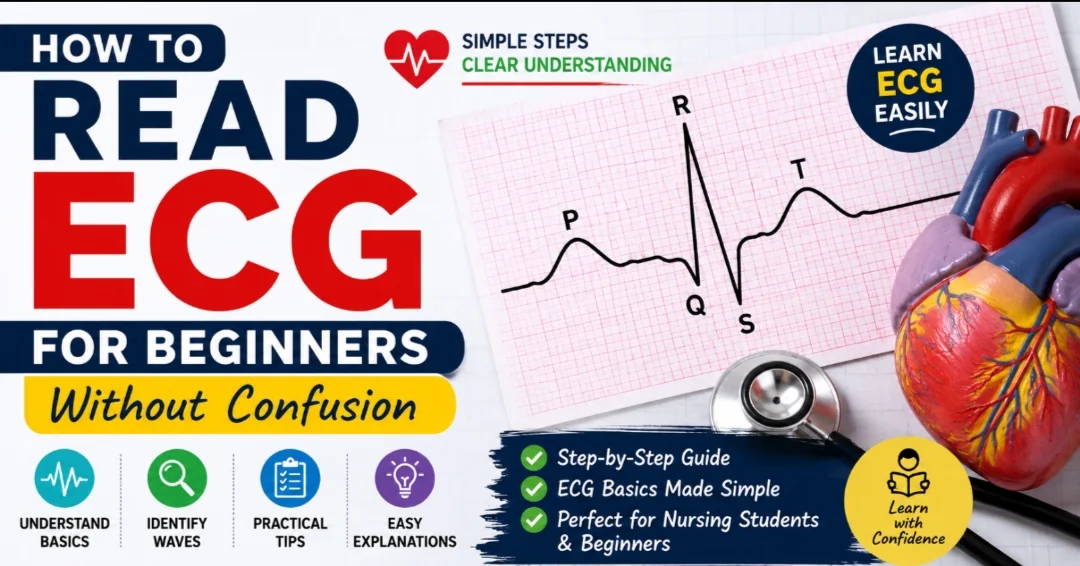
How to Read ECG for Beginners Without Confusion

Meta Description:
Learn how to read ECG step by step without confusion. This beginner-friendly ECG interpretation guide explains heart rhythms, waves, intervals, and common abnormalities in simple language.
Introduction
Electrocardiography (ECG or EKG) is one of the most important skills in healthcare. Whether you are a nursing student, medical intern, cardiac technician, or ICU trainee, learning how to read an ECG can feel overwhelming at first.Many beginners struggle because ECG interpretation is often taught in a complicated way filled with difficult medical terms and memorization. But the truth is simple:ECG reading becomes easy when you understand the basics step by step.

In this guide, you will learn:-
What an ECG actually shows
– ECG paper basics
– ECG waves and intervals
– A simple method to read any ECG
– Common heart rhythms
– Beginner mistakes to avoid
What Is an ECG?
An ECG (Electrocardiogram) records the electrical activity of the heart.Every heartbeat produces electrical signals that travel through the heart muscle. The ECG machine detects these signals and displays them as waves on graph paper or a monitor.
Doctors and nurses use ECGs to identify:
– Heart rate- Heart rhythm
– Arrhythmias
– Heart attacks
– Electrolyte imbalance
– Conduction abnormalities

Why Learning ECG Is Important
ECG interpretation is essential in:
– ICU- Emergency department
– Cath lab
– Operation theater
– Ambulance services
– Cardiology clinics
Even basic ECG knowledge can help healthcare workers detect life-threatening problems early.
Understanding ECG Paper
Before learning rhythms, you must understand ECG paper.ECG paper contains:
– Small boxes
– Large boxes
– Horizontal lines
– Vertical lines
Each box represents time and voltage.ECG Paper Timing
Small Box
– 1 small box = 0.04 seconds
Large Box
– 1 large box = 0.20 seconds
5 Large Boxes- Equals 1 second
This timing system helps calculate heart rate and intervals.

Basic Parts of an ECG
A normal ECG contains several waves.These include:
– P wave- QRS complex
– T waveLet us understand each one simply.
P Wave
The P wave represents:
Atrial depolarizationThis means the electrical signal is traveling through the atria.Normal P Wave Characteristics- Small and rounded- Present before every QRS complex
If the P wave is absent or abnormal, it may indicate atrial arrhythmias.
QRS Complex
The QRS complex represents:
Ventricular depolarization
This is the contraction of the ventricles.
Normal QRS Duration- Less than 0.12 seconds
A wide QRS may suggest:
– Bundle branch block
– Ventricular rhythm
– Hyperkalemia
T Wave
The T wave represents:
Ventricular repolarization
This is when the ventricles recover electrically after contraction.
Tall or inverted T waves may indicate:
Electrolyte imbalance
– Ischemia
– Myocardial infarction
PR Interval
The PR interval is measured from:
– Beginning of P wave- Beginning of QRS complex
Normal PR Interval- 0.12 to 0.20 seconds
A prolonged PR interval may indicate:
– First-degree heart block
QT Interval
The QT interval represents total ventricular activity.A prolonged QT interval can increase the risk of dangerous arrhythmias.
Causes include:
– Certain medications
– Electrolyte imbalance
– Congenital conditions

Step-by-Step Method to Read ECG Easily
Most beginners become confused because they try to analyze everything at once.Instead, use this simple sequence every time.
Step 1: Check the Heart Rate
First determine whether the heart rate is:
– Normal
– Fast
– Slow
Normal Heart Rate- 60–100 beats per minute
Bradycardia- Less than 60 bpm
Tachycardia- More than 100 bpm
Simple Heart Rate Calculation Method
Count the large boxes between two R waves.
Use this rule:
– 1 large box = 300 bpm
– 2 large boxes = 150 bpm
– 3 large boxes = 100 bpm
– 4 large boxes = 75 bpm
– 5 large boxes = 60 bpm
This is the easiest method for beginners.
Step 2: Check Rhythm Regularity
Now observe whether the rhythm is:
– Regular
– Irregular
Ask yourself:Are the R-R intervals equal?
If yes:– Rhythm is regular
If no:- Rhythm is irregular
Irregular rhythms may suggest:
– Atrial fibrillation
– Premature beats
– Heart blocks
Step 3: Look for P Waves
Ask:- Is there a P wave before every QRS?
– Are P waves regular?
If P waves are missing:
– Think about atrial fibrillation or junctional rhythm
Step 4: Measure PR Interval
Check whether the PR interval is normal.
If prolonged:
– Consider heart block
If shortened:
– Consider accessory pathway disorders
Step 5: Analyze QRS Complex
Check:– Width- Shape- Regularity
Narrow QRS
Usually originates above ventricles.
Wide QRS
Usually originates within ventricles.
Step 6: Observe ST Segment
The ST segment is very important.
ST Elevation
May indicate:– Acute myocardial infarction (heart attack)
ST Depression
May indicate:– Ischemia- Reduced blood flow
Always compare clinically.
Step 7: Examine T Waves
Check if T waves are:- Upright- Inverted- Tall- Peaked
Abnormal T waves may indicate:
– Electrolyte imbalance
– Cardiac ischemia
Normal Sinus Rhythm Explained
A normal sinus rhythm means the heart’s natural pacemaker is functioning properly.Features of Normal Sinus Rhythm- Heart rate 60–100 bpm- Regular rhythm- P wave before every QRS- Normal PR interval- Narrow QRS
This is the first rhythm every beginner should recognize.

Common ECG Rhythms Beginners Should Know
Sinus Bradycardia
Features
– Rate below 60 bpm
– Regular rhythm
Causes
– Athletes
– Sleep
– Beta blockers
– Hypothyroidism
Sometimes normal, sometimes pathological.
Sinus Tachycardia
Features
– Rate above 100 bpm
– Regular rhythm
Causes
– Fever
– Pain
– Anxiety
– Shock
– Exercise
Very common in emergency settings.
Atrial Fibrillation (AF)AF is one of the most common arrhythmias.
ECG Features
– Irregularly irregular rhythm
– No clear P waves
AF increases stroke risk.
Ventricular Tachycardia (VT)This is a dangerous rhythm.
ECG Features
– Wide QRS
– Fast heart rate
– Regular rhythm
VT can become life-threatening quickly.
Ventricular Fibrillation (VF)VF is a medical emergency.
ECG Features
– Chaotic irregular waves
– No organized rhythmThe patient becomes pulseless.Immediate CPR and defibrillation are required.
ECG Leads Explained Simply
ECG leads look at the heart from different angles.
Limb Leads- I- II- III- aVR- aVL- aVF
Chest Leads- V1 to V6
Each lead provides different information about heart activity.
ECG Lead Placement Basics
Correct lead placement is extremely important.
Incorrect placement can create:
– False abnormalities
– Misdiagnosis
– Wrong treatment decisions
Chest Lead Placement
V1
4th intercostal space, right sternal border
V2
4th intercostal space, left sternal border
V4
5th intercostal space, midclavicular line
V6
Midaxillary line
Beginners should practice lead placement repeatedly.

Common ECG Mistakes Beginners Make
1. Memorizing Without Understanding
Many students try to memorize rhythms blindly.This causes confusion later.
Understand:
– Electrical conduction
– Wave formation
– Heart physiology
Everything becomes easier afterward.
2. Ignoring Clinical Symptoms
Never interpret ECG alone.
Always consider:
– Chest pain
– Blood pressure
– Oxygen saturation
– Symptoms
ECG must match clinical condition.
3. Reading Too Fast
Beginners panic and rush.Follow the same sequence every time:
1. Rate
2. Rhythm
3. P wave
4. PR interval
5. QRS
6. ST segment
7. T wave
Consistency improves accuracy.
4. Not Practicing Daily
ECG is a skill.Reading one article is not enough.You improve by:
– Observing real ECGs
– Practicing rhythm recognition
– Reviewing abnormal cases
Even 15 minutes daily helps significantly.
Tips to Learn ECG Faster
Use Pattern Recognition
Experienced clinicians recognize ECGs by patterns.The more ECGs you see:- The easier interpretation becomes
Start With Normal ECGs
Learn normal first.Do not jump directly into complicated arrhythmias.
Practice One Rhythm Daily
Example:
– Monday: Sinus rhythm
– Tuesday: AF
– Wednesday: VT
This prevents overload.
—Use Mnemonics
Mnemonics help beginners remember concepts quickly.Example:“If the rhythm is irregularly irregular, think AF.”
Difference Between ECG and Echocardiography
Many beginners confuse ECG with Echo.
ECGShows:
– Electrical activity
EchoShows:
– Structural movement of the heart
ECG detects rhythm problems.Echo detects structural problems.Both are important in cardiology.
When Should ECG Be Done?
Doctors order ECGs for:
– Chest pain
– Palpitations
– Syncope
– Breathlessness
– Hypertension
– Preoperative evaluation
ECG is quick, painless, and extremely useful.
Is ECG Difficult to Learn?
No.ECG only appears difficult initially because of:
– Complex teaching methods
– Excessive memorization
– Fear of arrhythmias
Once you understand the basics step by step, ECG interpretation becomes much easier.Most healthcare professionals improve through repetition and clinical exposure.
Final Thoughts
Learning ECG interpretation is one of the most valuable skills in healthcare.Do not try to master everything in one day.Start with:- Normal rhythm- Basic waves- Simple rate calculation- Common arrhythmiasThen gradually move toward advanced interpretation.The key is consistency.With regular practice, ECG reading becomes less confusing and much more logical.
.Frequently Asked Questions
What is the easiest way to learn ECG?
The easiest method is learning step by step:
1. Rate
2. Rhythm
3. P wave
4. PR interval
5. QRS
6. ST segment
7. T wave
Consistent practice improves confidence.
How long does it take to learn ECG?
Basic ECG interpretation may take a few weeks with daily practice. Advanced interpretation takes months or years of clinical exposure.
What is the normal heart rate on ECG?
Normal heart rate is:60–100 beats per minute
Why are ECG leads important?
ECG leads observe the heart from different angles, helping identify abnormalities accurately.
What is the most dangerous ECG rhythm?
Ventricular fibrillation (VF) is one of the most dangerous rhythms because it can rapidly cause cardiac arrest.