
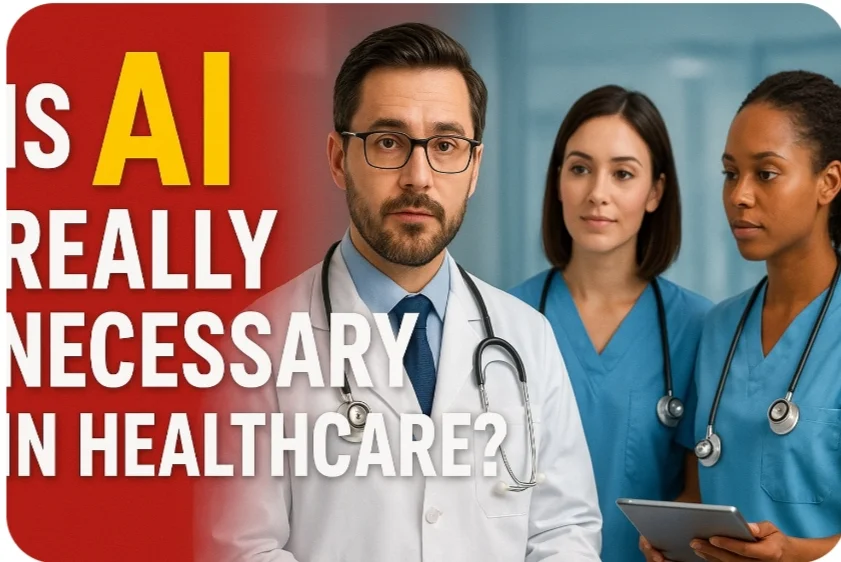
Is AI Really Necessary in Healthcare? Benefits, Risks & Real-World Examples

Meta Description–
Is AI necessary in healthcare? Explore how Artificial Intelligence is transforming diagnosis, treatment, nursing care, and hospital operations. Learn the benefits, risks, limitations, and real-world examples shaping the future of modern healthcare.
Artificial Intelligence (AI) is no longer just a futuristic idea — it is rapidly becoming a core part of modern healthcare. From predicting diseases early to assisting doctors in surgery, AI is transforming the way hospitals operate and how patients receive care. But many healthcare workers still ask an important question:“Is AI really necessary in healthcare, or is it just a trend?”
In this in-depth article, we explore why AI is being adopted worldwide, the benefits, risks, real-world examples, and what this means for doctors, nurses, and patients.
—⭐ Why AI Is Becoming Necessary in Today’s Healthcare SystemHealthcare systems across the world are facing major challenges:
Shortage of doctors and nursesIncreasing patient loadRising chronic diseasesDelays in diagnosisMedical errorsTime-consuming documentationAI has emerged as a powerful solution because it can analyze huge amounts of data quickly, reduce workload, and support clinical decision-making.AI does not replace healthcare workers.Instead, it assists them — making care faster, safer, and more accurate.
—What Exactly Is AI in Healthcare?
AI in healthcare refers to computer systems that can:
Analyze medical data
Predict diseases
Support diagnosisAssist in treatment planning
Automate routine tasks
Improve clinical accuracy
Enhance patient monitoring
Examples include:
✔ AI-powered ECG and X-ray interpretation
✔ Virtual nursing assistants
✔ AI chatbots for patients
✔ Robotic surgery
✔ AI alerts in critical care
✔ Early cancer detection algorithms

––🌟 Top Benefits of AI in Healthcare
1. Faster & More Accurate DiagnosisOne of the biggest advantages of AI is diagnostic accuracy.AI can detect patterns invisible to the human eye.
Examples:AI detects breast cancer from mammograms with up to 99% accuracy.AI-powered CT scan analysis can detect brain hemorrhage within seconds.AI identifies diabetic retinopathy, often before symptoms appear.This helps reduce delays and improves treatment outcomes.
—2. Reduced Workload for Doctors & NursesHealthcare staff are overwhelmed with:
DocumentationMedication charts
ReportsScheduling
Follow-up calls
Routine assessments
AI tools can automate 30–40% of these administrative tasks.
For Nurses:
AI can monitor vitals continuously and send alerts.
Virtual nursing assistants answer common patient questions.
Smart EMR systems reduce charting time.This allows nurses to spend more time on patient care, compassion, and communication.
—3. Early Prediction of DiseasesAI can analyze:
Blood reports
Lifestyle data
Genetic information
ImagingVital signs trends
This helps healthcare teams predict diseases before they become serious.
Examples:Heart attack prediction 5 years earlyLiver disease progression trackingEarly chronic kidney disease detectionSepsis prediction hours before symptomsEarly detection means better survival and fewer complications.
—4. Enhanced Patient Monitoring & SafetyAI-powered monitoring systems track:
Heart rate
Oxygen saturation
Respiratory patterns
Neurological signs
Behavior changes
AI sends automatic alerts to healthcare teams if any abnormal signs appear.This is especially helpful in:ICUsEmergency carePost-operative recoveryElderly patient care
—-5. Personalized Treatment PlansEvery patient is different — and AI helps design personalized care.AI can:
Suggest optimal medication doses
Predict treatment response
Recommend lifestyle interventions
Help plan chemotherapy schedules
Support clinical decision making
This leads to more effective, safer, and individualized treatment.
—6. Supporting Surgeries & Critical ProceduresAI assists surgeons through:
Robotic arms (extremely precise)
3D surgical planning
Real-time data guidance
Benefits include:
Smaller cutsLess blood lossFewer complications
Faster recoveryRobotic surgeries are becoming common in urology, oncology, gynecology, and orthopedic procedures.
—7. Improving Operational Efficiency in HospitalsAI helps hospitals with:
Predicting bed availabilityReducing waiting times
Managing emergency department
flowInventory and pharmacy automationResource allocation
Staff schedulingThis leads to a smooth, efficient workflow, and improves patient experience.

—🔍 Is AI Replacing Healthcare Workers?
No — AI is not designed to replace doctors, nurses, or technicians.Instead, it:
✔ Reduces workloads
✔ Improves decision-making
✔ Supports accuracy
✔ Enhances patient careHealthcare is a deeply human profession.Compassion, touch, communication, and emotional support cannot be replaced by machines.
AI only performs tasks that are:RepetitiveData-heavyPredictivePattern-basedHealthcare workers remain the heart of patient care.
—⚠️ Risks & Challenges of Using AI in HealthcareWhile AI brings huge benefits, it also comes with risks that must be carefully managed.
—1. Incorrect PredictionsAI may misinterpret data or produce errors if:
The input data is wrong
The system is poorly programmed
Bias exists in the training modelsThese errors can affect diagnosis or treatment.
—2. Privacy & Data Security ConcernsHealthcare data is extremely sensitive.Risks include:
Data breachesHackingMisuse of patient informationHospitals must maintain strict cybersecurity standards.
—3. Lack of Human TouchAI cannot:Understand emotions
Build trust
Provide empathyOffer comfortHealthcare depends heavily on human connection.AI must not replace this essential component.
—4. High Cost of AI ImplementationMany hospitals struggle with:
High cost of advanced AI tools
Staff trainingSystem
maintenanceInfrastructure
upgradesSmaller hospitals may face difficulties adopting AI.
––5. Fear Among Healthcare WorkersSome professionals fear:
Job loss
Increased monitoring
Reduced autonomy
Proper training and clear communication can reduce this fear.

––🌍 Real-World Examples: How AI Is Already Saving LivesHere are some global examples of AI actively used in healthcare today:
—1. Google’s DeepMind for Eye Disease AI detects over 50 types of eye diseases earlier than human specialists.It helps prevent irreversible blindness.
—2. IBM Watson for Cancer TreatmentWatson analyzes patient records and suggests evidence-based treatment plans.
—3. AI-Powered CT Scan Analysis in Stroke AI detects stroke types within seconds, helping doctors start life-saving care immediately.
—4. Nursing Robots in JapanRobots assist with:Lifting patientsDelivering medicationsMonitoring basic vitalsThis reduces nurses’ physical workload.-
–5. Chatbots for Mental Health AI chatbots provide therapy support and early stress detection
—6.Smart ICU Monitoring
AI continuously checks every second of patient data and alerts staff early for:
Sepsis,Arrhythmia, Hypoxia, Sudden deterioration
Many ICUs have seen reduced mortality rates.
—-🌟 Why AI Is the Future of HealthcareAI is not a luxury — it is becoming necessary.
Reasons:
Healthcare demands are rising
Staff shortages are increasing
Patients expect faster results
Technology is advancing rapidly
Precision medicine is the future
AI helps healthcare workers give better, faster, safer, and more personalized care.
––💡 Final Conclusion:
Is AI Necessary in Healthcare?Yes, AI is necessary — but not as a replacement for healthcare workers.AI is necessary because it:Improves Accuracy reduces Workload predicts diseases Early enhances patient Safety supports critical Decisions saves time and Cost improves hospital Efficiency but it must be used responsibly, with strong human supervision.
Healthcare will always remain a combination of:
✔ Human compassion
✔ Clinical knowledge
✔ Smart technology
Together, they create a stronger, safer, and more efficient healthcare system.
FAQs
1. Why is AI becoming important in healthcare?
AI is becoming important because it improves diagnostic accuracy, reduces workload, predicts diseases early, enhances patient safety, and increases hospital efficiency. It helps healthcare professionals make faster and more reliable clinical decisions.
—2. Will AI replace doctors or nurses?
No. AI does not replace healthcare workers. Instead, it assists them by handling repetitive and data-heavy tasks. Doctors and nurses continue to provide essential human judgment, compassion, and patient communication.
—3. What are the risks of using AI in healthcare?
The major risks include incorrect predictions, data privacy concerns, technical failures, bias in algorithms, and high implementation costs. Strong human supervision is necessary to ensure AI decisions are accurate and safe.
—4. How does AI help nurses in daily clinical practice?
AI supports nurses by automating documentation, monitoring vital signs, reducing medication errors, providing decision support, and improving workflow. It saves time and allows nurses to focus more on patient care.
—5. What are some real examples of AI used in hospitals?
Examples include AI for stroke detection, robotic surgery assistance, smart ICU monitoring, virtual nursing assistants, AI-powered image interpretation, and chatbots for mental health support.
—6. Is AI accurate in diagnosing diseases?
AI has shown extremely high accuracy in diagnosing certain conditions like breast cancer, diabetic retinopathy, pneumonia, and stroke. However, accuracy depends on data quality and must be verified by healthcare professionals.
—7. Is AI expensive for hospitals?
Yes, AI implementation can be costly because it requires hardware, software, trained staff, and ongoing maintenance. However, long-term benefits often outweigh initial investment.
—8. How does AI improve patient safety?
AI systems continuously monitor patients, detect early signs of deterioration, reduce medication errors, and assist in accurate diagnosis — all of which improve patient outcomes.