
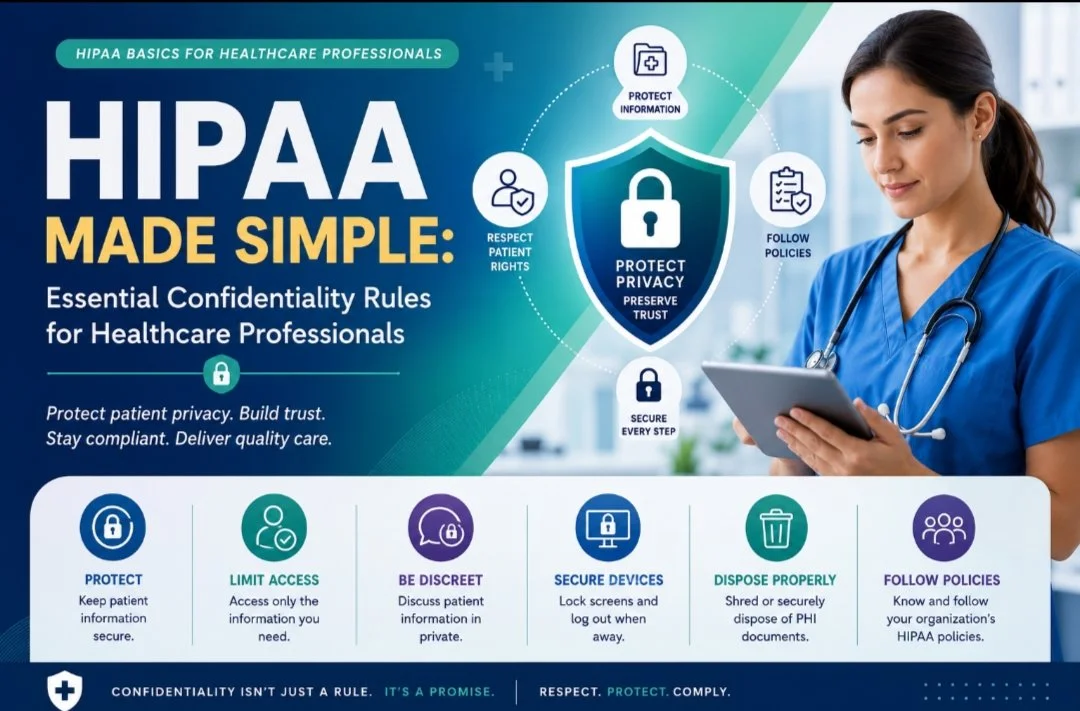
HIPAA Made Simple: Essential Confidentiality Rules for Healthcare Professionals

Meta Description:
HIPAA made simple for nursing students and new nurses: learn the history, core rules, common violations, and best practices for protecting patient confidentiality at work.
HIPAA Made Simple: Essential Confidentiality Rules for Healthcare Professionals
For every nursing student walking onto a unit for the first time, and for every new graduate nurse settling into their first job, one acronym follows closely behind: HIPAA. It appears in orientation packets, hospital policy manuals, and the fine print of every consent form a patient signs. Yet despite how often the term comes up, many nurses enter practice with only a surface-level understanding of what HIPAA actually requires, why it exists, and what happens when it is violated.
This guide breaks HIPAA down into plain language. It covers where the law came from, what it actually says, the mistakes that most commonly land nurses in trouble, and the everyday habits that keep patient information secure. The goal is not to memorize legal text, but to understand HIPAA well enough to practice confidently and protect both your patients and your license.
What Is HIPAA, and Why Does It Exist?
HIPAA stands for the Health Insurance Portability and Accountability Act, a federal law passed by the United States Congress in 1996. The name itself hints at its original purpose: the law was designed in part to help workers keep their health insurance coverage when they changed or lost jobs, a real problem in the mid-1990s healthcare landscape.
But HIPAA’s most lasting impact came from a different provision entirely. As healthcare records began shifting from paper charts to electronic systems, lawmakers recognized that patient information was becoming easier to copy, transmit, and potentially misuse. In response, HIPAA established national standards for protecting the privacy and security of health information, standards that did not fully exist before.
Two major rules eventually grew out of this law and now form the backbone of healthcare confidentiality practice:
The Privacy Rule (2003): Establishes who can access patient health information, under what circumstances, and what rights patients have over their own records.
The Security Rule (2005): Sets specific standards for protecting electronic health information, including safeguards for storage, transmission, and access.
Together, these rules govern nearly every interaction a nurse has with patient information, from a bedside conversation to a note typed into an electronic health record.

The Core Idea Behind HIPAA: Protected Health Information
At the center of HIPAA is a concept called Protected Health Information, commonly abbreviated as PHI. PHI includes any information that could identify a patient and relates to their health condition, treatment, or payment for care. This is a broader category than most new nurses expect.
PHI is not limited to diagnoses and lab results. It also includes:
Patient names, addresses, and phone numbers
Dates related to care, including birth dates and admission dates
Photographs or identifiable images
Medical record numbers and insurance details
Any conversation about a patient’s condition, even an informal one
A useful way to think about it: if the information could reasonably be traced back to a specific patient, and it touches on their health or care, it is likely PHI. This applies whether the information is written, spoken, or stored electronically.
Who HIPAA Applies To
HIPAA regulations apply to what the law calls “covered entities” and their “business associates.” For a working nurse, this distinction matters less than the practical reality: if you have access to patient information as part of your job, HIPAA applies to you.
This includes:
Nurses, physicians, and other direct care providers
Nursing students completing clinical rotations
Administrative and billing staff
IT personnel who maintain electronic health record systems
Any contracted service with access to patient data
Nursing students are sometimes surprised to learn that HIPAA obligations apply to them from their very first clinical rotation, not just after graduation and licensure. The moment a student has access to a patient chart or overhears protected information during a shift, the same confidentiality expectations apply.
The Minimum Necessary Standard
One of the most practical concepts in HIPAA is the “minimum necessary” standard. This rule states that healthcare workers should only access, use, or share the minimum amount of PHI needed to complete a specific task.
In practice, this means a nurse caring for a patient on a medical-surgical floor has no legitimate reason to look up the chart of a family member being treated in the emergency department, even out of concern or curiosity. It also means that when discussing a patient’s care with a colleague, the conversation should stay focused on what that colleague actually needs to know to do their job.
This standard is frequently misunderstood as being about restricting care. It is not. Nurses can and should access whatever information they need to provide safe, effective treatment. The standard exists to prevent unnecessary or curious access to information that has no bearing on someone’s actual role in a patient’s care.
Common HIPAA Violations Nurses Should Know
Understanding HIPAA in the abstract is one thing. Recognizing violations as they happen in daily practice is another. Some of the most common HIPAA violations among nursing staff are not intentional data breaches, but everyday lapses that happen when confidentiality becomes an afterthought.
Discussing patients in public or semi-public spaces. Elevators, cafeterias, and hallways are common settings for HIPAA violations. A conversation that feels private between two colleagues can easily be overheard by visitors, other patients, or family members nearby.
Accessing records without a care-related reason. Curiosity is one of the most common drivers of HIPAA violations. Looking up a coworker’s chart, a public figure’s admission, or a family member’s test results without a legitimate clinical reason is a violation, even if the information is never shared with anyone else.
Posting on social media. Even without using a patient’s name, posts describing a “wild case” from a shift, photos taken in patient care areas, or details specific enough to identify someone can constitute a violation. Healthcare workers have lost jobs and licenses over social media posts that felt harmless at the time.
Leaving information visible or accessible. Charts left open on unattended computer screens, printed documents left at a nurses’ station, or handoff notes left in view of visitors all create exposure risk.
Improper disposal of documents. Patient information printed for reference during a shift needs to be shredded or disposed of through approved channels, not thrown in a regular trash bin.
Sharing login credentials. Logging into an electronic health record under someone else’s credentials, or allowing a colleague to use yours, undermines the entire system of access tracking that HIPAA relies on.
None of these examples involve malicious intent. That is precisely why they are worth studying closely: HIPAA violations are far more often the result of routine habits than deliberate wrongdoing.
Consequences of HIPAA Violations
The consequences of a HIPAA violation depend on its severity, whether it was intentional, and how it is handled once discovered. For an individual nurse, potential consequences include employer disciplinary action, termination, professional licensing board investigation, and in serious cases, civil or criminal penalties.
Healthcare organizations that fail to maintain adequate HIPAA safeguards can face significant financial penalties from the U.S. Department of Health and Human Services Office for Civil Rights, which enforces HIPAA at the federal level. These penalties can range from modest fines for minor, corrected violations to substantial sums for willful neglect.
For new nurses, the more immediate concern is usually professional. A documented HIPAA violation can follow a nurse’s employment record and, depending on the nature of the violation, may be reportable to a state board of nursing. This is one of the reasons HIPAA training is taken so seriously during nursing school and hospital onboarding: the professional stakes are real from day one of clinical practice.

Best Practices for Maintaining HIPAA Compliance
Protecting patient confidentiality does not require memorizing legal statutes. It requires building a small set of habits into daily practice until they become automatic.
Keep patient conversations in appropriate spaces. Reserve discussions about a patient’s condition for private areas such as a report room or a patient’s room with the door closed, away from other patients, visitors, and public traffic.
Log out of shared devices. Any time you step away from a workstation, even briefly, log out or lock the screen. This single habit prevents a significant share of accidental exposure incidents.
Access only what your role requires. Before opening a chart, ask whether you have a legitimate, care-related reason to do so. If the answer is no, don’t access it.
Think before you post. Avoid discussing work experiences on social media in any way that could identify a patient, even indirectly. When in doubt, don’t post it.
Secure physical documents. Keep printed materials with patient information out of view, and dispose of them through designated shredding bins rather than regular trash.
Report concerns promptly. If you witness a potential HIPAA violation, whether your own or a colleague’s, report it through your facility’s proper channels. Early reporting often reduces the severity of consequences and demonstrates a commitment to patient protection.
Ask when uncertain. HIPAA has enough nuance that even experienced nurses occasionally face gray-area situations. When uncertain whether sharing information is appropriate, checking with a supervisor, charge nurse, or your facility’s compliance officer is always the safer choice.

Why HIPAA Matters Beyond Compliance
It is easy to think of HIPAA purely as a regulatory hurdle, something to complete during orientation and avoid violating out of fear of consequences. But at its core, HIPAA reflects something more fundamental to nursing practice: patient trust.
Patients share deeply personal information with healthcare providers, often during some of the most vulnerable moments of their lives. That willingness to share depends on a reasonable expectation that the information will be protected. Every time a nurse safeguards a patient’s chart, closes a door before discussing a diagnosis, or resists the urge to look something up out of curiosity, they are reinforcing the foundation of trust that makes honest, effective healthcare possible.
For nursing students and new graduate nurses, building strong HIPAA habits early is not just about avoiding disciplinary action. It is about developing into the kind of clinician patients can trust with their most sensitive information, which is, in many ways, the heart of the nursing profession itself.
Frequently Asked Questions
What does HIPAA stand for?
HIPAA stands for the Health Insurance Portability and Accountability Act, a federal law passed in 1996 that established national standards for protecting patient health information.
Does HIPAA apply to nursing students?
Yes. Nursing students are held to the same confidentiality standards as licensed staff from the moment they gain access to patient information during clinical rotations.
Can I discuss a patient with a family member without violating HIPAA?
Generally, no, unless the patient has given permission or the family member is an authorized representative. Information should only be shared with individuals the patient has approved or who have a legitimate care-related need.
Is it a HIPAA violation to look up a coworker’s medical record out of concern?
Yes. Accessing any patient record without a direct, care-related reason is a violation, regardless of the intent behind it.
What should I do if I accidentally see or share PHI inappropriately?
Report the incident to your supervisor or facility compliance officer immediately. Prompt reporting is taken seriously and often reduces the severity of consequences compared to concealment.
Can HIPAA violations affect my nursing license?
Depending on severity, HIPAA violations can be reportable to a state board of nursing and may result in disciplinary action against a nursing license, in addition to any employer-level consequences.