
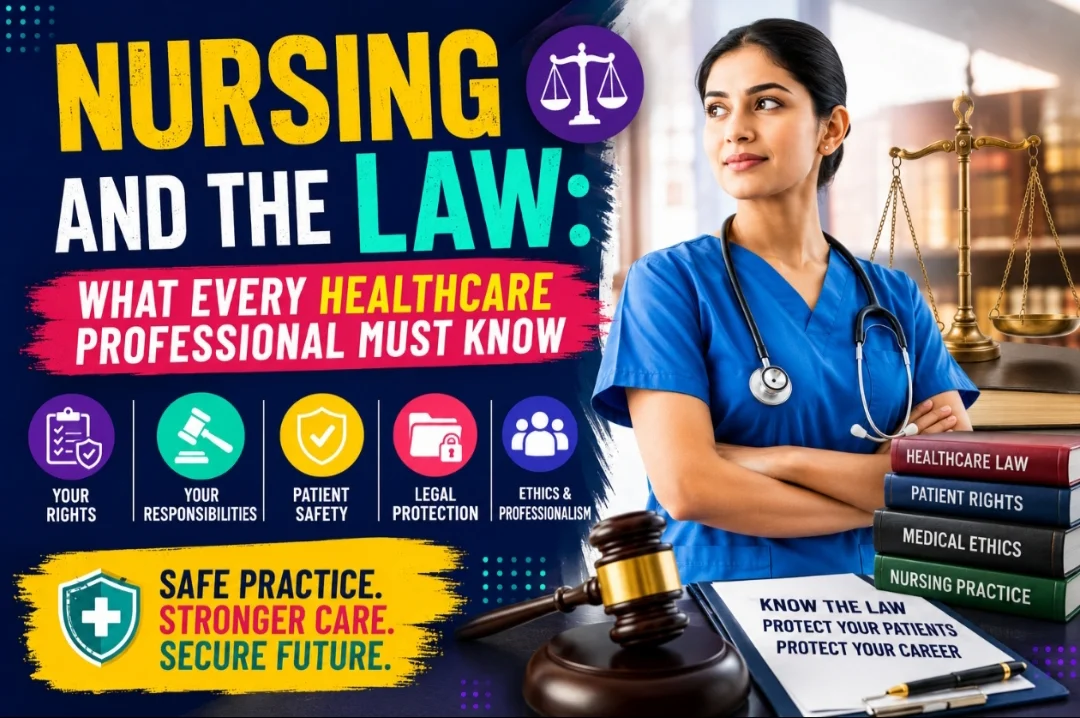
Nursing and the Law: What Every Healthcare Professional Must
A complete, practical guide to legal responsibilities, patient rights, and how nurses can protect themselves and their patients every single day.

Nursing is one of the most trusted professions in the world. But that trust comes with serious legal responsibility. Understanding the law isn’t just for lawyers — it’s something every nurse, nursing student, and healthcare professional needs to know.
Today’s healthcare environment moves fast. A single error in medication administration, documentation, or patient communication can lead to serious legal consequences — not just for the patient, but for your career. The good news? Most legal problems in nursing are entirely preventable.
This guide breaks down everything you need to know about nursing law in plain, practical language — from patient rights and informed consent to medication safety, documentation, and social media risks. Whether you’re a new graduate or a seasoned professional, this is essential reading.
📋 What’s Covered in This Article
- What Is Nursing Law?
- Why Legal Knowledge Matters
- Legal Responsibilities of Nurses
- Common Legal Issues in Nursing
- Informed Consent
- Patient Rights
- Social Media & Legal Risks
- Tips to Stay Legally Safe
- Ethical Principles in Nursing
- Frequently Asked Questions

What Is Nursing Law?
Nursing law refers to the body of legal rules, regulations, and standards that govern how nurses practice. These laws exist for a clear reason: to protect patients, maintain professional standards, and define the boundaries of nursing practice.
While specific laws vary between countries and healthcare organizations, the core goals are universal. Every nurse is legally accountable for their actions — and inactions — during patient care. This accountability is what makes understanding nursing law so critical.
Nursing law covers everything from how medications are administered and how records are documented, to how patient information is shared and what to do in an emergency. Ignorance of these laws is not a legal defense.

Why Legal Knowledge Is Essential for Every Nurse
Patients today are more informed and more aware of their rights than ever before. Healthcare organizations are under increasing pressure to provide safe, evidence-based, and ethical care. In this environment, a nurse who lacks legal awareness can unknowingly put both patients and their own career at serious risk.
Legal knowledge helps nurses practice with confidence, reduce errors, protect their professional license, and build stronger trust with patients and colleagues. It also helps healthcare teams avoid costly lawsuits and disciplinary actions that disrupt patient care and damage institutional reputation.
Think of legal awareness not as a burden, but as a professional superpower — one that makes you a safer, more confident, and more effective nurse.
Core Legal Responsibilities of Nurses
Nurses carry a wide range of legal duties in clinical practice. Failing to meet any of these can lead to disciplinary action, legal claims, or loss of licensure. Here are the core responsibilities every nurse must uphold:
- ✓Safe Patient CareAlways provide care that meets the accepted standard within your scope of practice.
- ✓Accurate Medication AdministrationFollow the 10 Rights of medication administration without shortcuts.
- ✓Thorough DocumentationRecord all care provided promptly, accurately, and objectively.
- ✓Patient ConfidentialityProtect all patient information — verbal, written, and digital.
- ✓Prompt ReportingReport abnormal findings, changes in condition, and incidents without delay.
- ✓Respecting Patient RightsAdvocate for patients’ rights to information, dignity, and autonomy.

The 5 Most Common Legal Issues in Nursing
Understanding where legal risks arise is the first step to preventing them. These five areas account for the majority of legal complaints and disciplinary actions in nursing practice.
💊
1. Medication Errors
Medication errors are among the most frequent causes of legal action in healthcare. These include giving the wrong medication, the wrong dose, to the wrong patient, via the wrong route, or at the wrong time.
High-risk medications like insulin, anticoagulants, and opioids demand extra vigilance. A single insulin overdose, for example, can trigger life-threatening hypoglycemia within minutes.
✅ Prevention Strategies
- Follow the 10 Rights of medication administration
- Double-check every high-alert medication
- Read labels carefully — every single time
- Clarify any unclear or ambiguous prescription
- Eliminate distractions during medication preparation
📝
2. Poor Documentation
In a court of law, medical records are treated as legal evidence. If a nursing action isn’t documented, it’s as if it never happened. Incomplete, late, or falsified records are among the most damaging issues a nurse can face legally.
Common mistakes include late charting, missing vital signs, incomplete patient assessments, altered records, and the use of unclear abbreviations.
✅ Documentation Best Practices
- Chart immediately after providing care
- Use clear, objective, professional language
- Record patient responses to treatments
- Never alter or falsify any record
- Avoid vague or ambiguous abbreviations
⚠️
3. Negligence and Malpractice
Negligence occurs when a nurse fails to meet the expected standard of care, resulting in patient harm. When this negligence is committed by a licensed healthcare professional, it becomes malpractice — a serious legal claim that can end careers.
Examples include failing to monitor patients properly, ignoring abnormal vital signs, delayed reporting of deteriorating conditions, or performing procedures without adequate training.
✅ How to Reduce Your Risk
- Always stay within your scope of practice
- Follow your hospital’s protocols and policies
- Ask for help when you’re unsure — always
- Pursue continuing education and skills updates
- Never perform a procedure you haven’t been trained for
🔒
4. Breach of Patient Confidentiality
Protecting patient information is both a legal requirement and an ethical duty. Confidentiality breaches can occur in surprisingly easy ways — a casual hallway conversation, an unlocked computer screen, or a social media post that seems harmless.
Even sharing information without naming the patient can violate privacy laws in many jurisdictions.
✅ Protecting Patient Privacy
- Follow your hospital’s privacy and data policies
- Access only the patient information you need
- Never discuss patients in public areas
- Use only approved, secure communication systems
- Lock workstations when stepping away
📢
5. Communication Failures
Poor communication is consistently identified as one of the leading causes of medical errors and patient harm. Problems can arise during shift handovers, emergency situations, verbal order-taking, or routine team updates.
A simple misheard medication name or a missed critical value during handover can have devastating consequences.
✅ Communication Safety Strategies
- Use the SBAR method for structured handovers
- Always read back verbal orders for confirmation
- Report critical changes in patient condition immediately
- Maintain respectful, clear communication with the whole team
“If it wasn’t documented, it wasn’t done.” — A fundamental rule that every nurse must live by.
Informed Consent: What Nurses Need to Understand
Informed consent means that a patient must fully understand a procedure, treatment, or intervention before legally agreeing to it. Patients have the right to receive clear information, ask questions, and — importantly — refuse treatment.
While it’s usually a physician’s responsibility to obtain formal consent, nurses play a crucial supporting role. If a patient appears confused, uninformed, or uncertain about what they’ve agreed to, it is the nurse’s duty to pause the procedure and notify the healthcare provider immediately.
Proceeding with a procedure on a patient who hasn’t given proper informed consent — even if another clinician obtained a signature — can expose a nurse to legal liability.

Patient Rights Every Nurse Must Advocate For
Patient rights aren’t optional — they are legally protected, and nurses are often the last line of defense in ensuring those rights are honored. Being a patient advocate is not just an ethical ideal; it is a legal responsibility.
Safe, quality care
Privacy and dignity
Clear information
Right to refuse treatment
Freedom from discrimination
Informed consent
Confidentiality
Respectful communication
When a nurse witnesses a violation of patient rights — whether by a colleague, physician, or institution — they are ethically and often legally obligated to speak up and report it through proper channels.

Social Media and the Law: A Growing Risk for Nurses
Social media has created an entirely new legal frontier for healthcare professionals. What you post online — even after hours, from your personal account — can have serious professional and legal consequences.
You don’t need to name a patient to violate their privacy. Posting about “a difficult case today,” sharing a photo from the unit, or discussing a workplace incident publicly can all constitute a confidentiality breach if there’s any chance the patient could be identified.
Nursing boards in many countries have issued disciplinary action — including license revocation — for social media violations. The rule is simple: if it involves patient care or your workplace, don’t post it.
✅ Safe Social Media Habits for Nurses
- Never post photos, videos, or descriptions of patients
- Don’t vent about workplace incidents on personal accounts
- Keep your social media identity separate from your professional role
- Read and follow your employer’s social media policy
- When in doubt — don’t post
A Preventable Legal Crisis
A nurse administered a medication without checking the patient’s allergy history. The patient developed a severe allergic reaction and required emergency ICU admission. An investigation revealed that the allergy was clearly documented in the patient’s chart — but the nurse had skipped the verification step while rushing through a busy shift.
What went wrong: Allergy verification was skipped. Safety protocols were bypassed. Documentation was incomplete.
The outcome: The nurse faced a formal disciplinary hearing, and the hospital was named in a negligence lawsuit.
The lesson: One basic safety check — checking allergy status — could have prevented the patient’s suffering, the legal proceedings, and significant damage to the nurse’s career. Speed is never worth a shortcut in patient safety.

7 Practical Tips to Stay Legally Protected as a Nurse
Legal safety in nursing doesn’t require a law degree. It requires consistency, professionalism, and a commitment to best practices — every shift, every patient, every time.
- 1Know Your Scope of PracticeNever perform procedures you haven’t been trained and authorized to do. When in doubt, refer up.
- 2Follow Hospital PoliciesProtocols and guidelines aren’t bureaucracy — they’re your legal protection. Follow them consistently.
- 3Document Everything, ClearlyClear, timely, objective documentation is your strongest defense in any legal challenge.
- 4Communicate ProactivelyGood communication prevents the misunderstandings that lead to errors and complaints.
- 5Report Incidents HonestlyNever hide a mistake. Reporting promptly and honestly allows for correction — and protects you.
- 6Keep LearningAttend training, stay updated on guidelines, and pursue continuing education. Knowledge is protection.
- 7Practice with Compassion and EthicsTreat every patient with dignity and respect. Ethical care and legal compliance go hand in hand.
Ethical Principles That Underpin Legal Nursing Practice
Legal practice and ethical practice are deeply intertwined. When nurses uphold the core principles of nursing ethics, they naturally align with legal requirements as well. These five principles form the ethical foundation of nursing:
🤝
Beneficence
Always act in the patient’s best interest
🛡️
Nonmaleficence
First, do no harm — in any form
🗣️
Autonomy
Respect the patient’s right to choose
⚖️
Justice
Treat every patient fairly and without bias
🔒
Confidentiality
Guard patient information absolutely
Frequently Asked Questions
What is the difference between nursing negligence and malpractice?
Negligence is a failure to provide the expected standard of care that results in patient harm. Malpractice is a specific type of negligence committed by a licensed professional — like a nurse or doctor — in the course of their professional duties. All malpractice is negligence, but not all negligence qualifies as malpractice.
Can a nurse be sued personally for a medication error?
Yes. While hospitals often share liability in medical negligence cases, individual nurses can and do face personal legal action for medication errors, especially if protocols were clearly not followed. This is why professional liability insurance is strongly recommended for nurses.
What should I do if I make a clinical mistake?
Report it immediately to your supervisor and follow your hospital’s incident reporting procedure. Ensure the patient receives appropriate care. Document what happened clearly and accurately. Do not attempt to alter records or conceal the error — doing so makes the legal situation significantly worse.
Is it illegal to discuss patient cases with family members?
Yes, unless the patient has given explicit consent for family members to receive information. Even then, information should only be shared on a need-to-know basis. Always confirm consent status and follow your hospital’s protocols before sharing any patient information.
How important is continuing education for legal compliance?
Extremely important. Healthcare laws, standards of care, and clinical guidelines evolve constantly. A nurse who is not up to date with current practices may inadvertently fall below the legal standard of care. Continuing education is both a professional obligation and a legal safeguard.
Final Thoughts: Legal Awareness Is Patient Care
Understanding nursing law isn’t about living in fear of lawsuits. It’s about being the best, safest, most professional nurse you can be. When you document clearly, communicate effectively, respect patient rights, and stay within your scope of practice, you’re not just following the law — you’re delivering excellent care.
Most legal problems in nursing are preventable. Knowledge, consistency, and compassion are your strongest protections.
“Safe nursing practice is the strongest legal protection you will ever have.”