
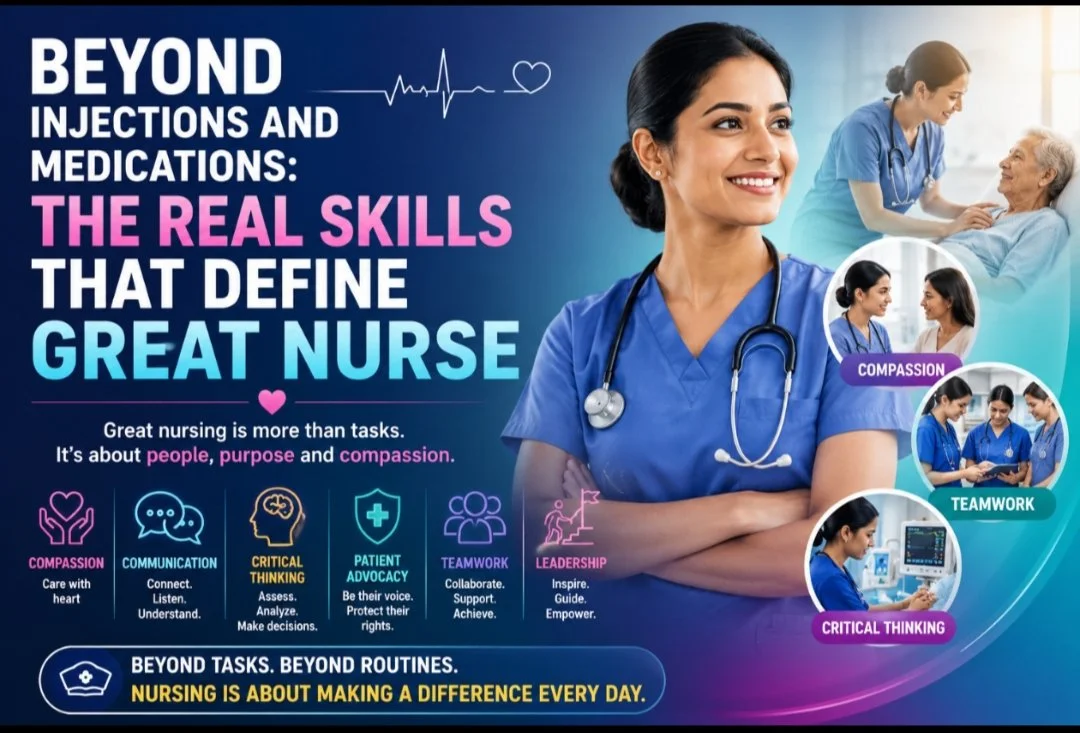
Beyond Injections and Medications: The Real Skills That Define Great Nurse

Meta Description: Discover the skills that truly define great nurses—beyond injections and medications. Learn how communication, critical thinking, and emotional intelligence shape exceptional nursing care.
Beyond Injections and Medications: The Real Skills That Define a Great Nurse
Ask most people outside healthcare what nurses do, and you’ll likely hear about needles, pills, and vital signs. It’s an understandable assumption. Technical tasks are visible, easy to describe, and central to nursing education from the very first semester. But ask any nurse who has spent real time at the bedside what actually separates a competent nurse from a truly great one, and the answer rarely centers on technique alone.
The truth is that clinical skills get you in the door. They are the baseline, the non-negotiable foundation taught in nursing school and tested on the NCLEX. But the qualities that define exceptional nursing—the ones patients remember, the ones colleagues trust, the ones that hold a unit together during a crisis—live in a different category altogether. They are harder to measure, rarely covered in a single lecture, and often learned only through experience, mentorship, and a willingness to keep growing long after graduation.
For nursing students and new nurses building a career, understanding these less visible skills early can make the difference between simply surviving the profession and genuinely thriving in it.

Why Technical Competence Is Only the Starting Point
Nursing programs are, by necessity, heavily focused on technical mastery. Students spend countless hours practicing injections, calculating dosages, reading lab values, and learning the mechanics of patient assessment. This focus makes sense: errors in these areas can be dangerous, and competence here is what allows a nurse to practice safely.
But technical skill is a threshold requirement, not a differentiator. Every licensed nurse, by definition, has demonstrated baseline clinical competence. What separates an adequate nurse from an outstanding one is everything that happens around the technical task—the way a difficult conversation is handled, the judgment call made under pressure, the ability to notice what a chart doesn’t say.
Patients rarely remember the precision of an IV insertion. They remember whether someone made eye contact while explaining what was happening. They remember whether their fear was acknowledged or brushed aside. Years later, what lingers isn’t the procedure itself—it’s how it felt to be cared for during it. That feeling is built entirely on the skills this article explores.
Communication: The Skill That Underlies Every Other Skill
If there is one capability that shows up in nearly every study on patient satisfaction, medical error prevention, and team performance, it’s communication. Nurses spend more time talking—to patients, families, physicians, and each other—than they spend performing any single clinical task. Yet communication is often treated as a soft skill, something nurses are simply expected to “have,” rather than something deliberately taught and refined.
Great communicators in nursing do several things consistently. They explain medical information in language patients can actually understand, without diluting its accuracy. They ask questions that invite real answers rather than yes-or-no responses. They listen for what isn’t being said, since fear, embarrassment, or confusion often hide behind a patient’s silence or vague reassurance that “everything is fine”.
Communication also extends to the care team. A nurse who can deliver a clear, organized SBAR report to a physician at 3 a.m.—Situation, Background, Assessment, Recommendation—can directly influence how quickly a patient receives the intervention they need. Miscommunication during handoffs remains one of the most cited contributors to preventable adverse events in hospitals, which is precisely why structured communication tools exist in the first place. Mastering them isn’t bureaucratic box-checking; it’s a direct extension of patient safety.
For new nurses, the most practical way to build this skill is through deliberate practice: rehearsing handoff reports out loud, asking preceptors for direct feedback on patient explanations, and paying close attention to how experienced nurses phrase difficult conversations.
Critical Thinking and Clinical Judgment
Nursing school teaches the nursing process: assess, diagnose, plan, implement, evaluate. It’s a useful framework, but in practice, real patient care rarely unfolds in such a clean, linear sequence. A patient’s condition can shift in minutes. Lab values can contradict what the physical exam suggests. A family member’s offhand comment might reveal something no assessment tool was designed to catch.
This is where critical thinking distinguishes itself from simple rule-following. A nurse who has memorized normal ranges and protocol steps can function adequately when everything goes as expected. A nurse with strong clinical judgment can recognize when something doesn’t fit the expected pattern—even before they can fully articulate why—and knows how to investigate that instinct rather than dismiss it.
This is also the foundation behind the Next Generation NCLEX’s emphasis on clinical judgment measurement. The exam isn’t simply testing whether a student knows facts; it’s testing whether they can apply those facts under the kind of ambiguity real patients present. That same skill, refined over years of practice, becomes what experienced nurses often describe as clinical intuition: not a mystical sixth sense, but the product of countless pattern-recognition moments that have been internalized so deeply they surface as a feeling before they surface as a fully reasoned thought.
New nurses can accelerate the development of this skill by routinely asking themselves “why” during every shift. Why did the physician choose this medication over an alternative? Why does this patient’s presentation not quite match the textbook description? Building the habit of curious, structured questioning lays the groundwork for judgment that no skills checklist can teach directly.

Emotional Intelligence and the Art of Presence
Nursing places people in some of the most emotionally charged moments of human life: birth, death, diagnosis, fear, recovery, and loss. Emotional intelligence—the ability to recognize, understand, and manage both your own emotions and those of others—isn’t a bonus trait in this environment. It’s operationally essential.
A nurse with strong emotional intelligence can walk into a room where a family has just received devastating news and adjust their entire approach within seconds: tone, pacing, body language, even the decision of whether to speak at all. They can recognize when a patient’s irritability is actually fear in disguise, or when a colleague’s short temper during a hard shift has nothing to do with the question just asked of them.
This skill also protects nurses themselves. Emotional intelligence includes self-awareness: noticing your own rising frustration, recognizing compassion fatigue before it becomes burnout, and knowing when to step back, breathe, or ask a colleague to take over a particularly difficult interaction. Nurses who develop this awareness early tend to have longer, more sustainable careers, because they learn to manage the emotional weight of the job rather than absorbing it indefinitely.
Presence is the practical expression of emotional intelligence at the bedside. It means being fully there with a patient for the two minutes you have, rather than mentally drafting your next task while nodding along. Patients can tell the difference, even when they can’t articulate it. That sense of being truly seen is often what they describe, long after discharge, as what made their care feel exceptional.
Adaptability in an Unpredictable Environment
No two shifts are alike, and few professions require adapting to change as constantly and consequentially as nursing. A nurse might walk in expecting a routine day and, within an hour, be managing a rapid response, comforting a grieving family, and fielding a call from a frustrated physician—all while still responsible for the rest of their patient assignment.
Adaptability here isn’t about tolerating chaos; it’s about functioning effectively within it. This requires the ability to reprioritize on the fly, to mentally triage which task absolutely cannot wait and which can be delayed by twenty minutes without harm. It also requires comfort with uncertainty, since not every clinical picture resolves neatly, and not every question has an immediate answer.
New nurses often find this the hardest skill to build, simply because nursing school, by its structure, presents fairly controlled learning scenarios. The transition to real clinical chaos can feel disorienting. The good news is that adaptability strengthens with exposure. Each unpredictable shift survived adds to a growing reservoir of confidence that the next one, however chaotic, is also survivable.
Advocacy: Speaking Up When It Matters Most
Patients are often at their most vulnerable when interacting with the healthcare system—frightened, in pain, unfamiliar with medical terminology, and sometimes unable to speak for themselves at all. Nurses occupy a unique position in this dynamic. They spend more continuous time with patients than any other member of the care team, which means they are often the first to notice a subtle decline, the first to hear a patient’s unspoken hesitation about a treatment plan, and frequently the last line of defense against a preventable error.
Advocacy means using that position deliberately. It means questioning an order that doesn’t seem right, even when doing so feels uncomfortable. It means ensuring a patient’s wishes, including end-of-life preferences or cultural considerations, are honored even when they complicate the easier path. It means recognizing that the quietest patient in the unit, the one who never presses the call button, may need attention just as urgently as the one who does.
This skill requires a particular kind of courage, especially for new nurses navigating hierarchical relationships with physicians and senior staff. Advocacy doesn’t require confrontation; it requires clarity, professionalism, and the confidence to trust your own assessment enough to voice it. Nurses who build this skill early tend to become the kind of clinician other staff specifically request for difficult patients, because they’re known for getting things right when it counts.
Time Management That Protects Patient Safety
Time management in nursing isn’t about productivity hacks or to-do lists; it’s a direct extension of patient safety. A medication given thirty minutes late, a wound dressing delayed past its scheduled change, or a post-operative assessment pushed back because of competing demands can each have real clinical consequences.
What separates skilled time managers in nursing isn’t simply working faster. It’s the ability to assess an entire patient assignment holistically and make continuous, informed judgment calls about sequencing. Which patient’s pain medication is overdue and likely to escalate if delayed further? Which assessment finding from earlier in the shift suggests a patient needs closer monitoring right now, even if nothing is scheduled?
This skill also includes knowing when and how to delegate. Recognizing which tasks can be safely handed to a certified nursing assistant or another team member, and communicating that delegation clearly, frees up critical thinking capacity for the tasks that genuinely require a nurse’s clinical judgment. New nurses sometimes struggle with delegation out of a sense that asking for help signals weakness. In reality, appropriate delegation is itself a marker of strong time management and team awareness.
Collaboration and Building Trust Across the Care Team
Healthcare is fundamentally a team sport, and nursing sits at its operational center. A single patient’s care might involve physicians, pharmacists, physical therapists, social workers, dietitians, and unlicensed assistive personnel, all coordinating around the same individual. Nurses are frequently the connective tissue holding that coordination together.
Strong collaborators understand that every member of the care team brings a different but valuable perspective, and they actively seek that input rather than working in isolation. They also understand the importance of clear, respectful communication even during disagreement, since friction within a care team can directly translate into fragmented or delayed patient care.
Building trust across the team takes time, but a few behaviors accelerate it: following through on commitments, communicating proactively rather than reactively, and treating every member of the team—regardless of title—with the same baseline respect. Nurses who build this kind of reputation early in their careers often find that colleagues become more willing to flag concerns to them, share information freely, and step in to help during difficult shifts. That reciprocity, built quietly over time, becomes one of the most valuable resources a nurse can have.
Resilience and Sustainable Self-Care
It would be incomplete to discuss the skills that define great nursing without addressing resilience. Nursing is physically and emotionally demanding in ways that compound over a career. Without intentional strategies for managing that demand, even highly skilled nurses can burn out, and burnout doesn’t just harm the nurse—it directly affects patient outcomes, since cognitive fatigue and emotional exhaustion are linked to increased error rates.
Resilience in nursing isn’t about suppressing difficult emotions or pushing through exhaustion indefinitely. It’s about developing sustainable habits: setting boundaries around overtime when possible, building a support system of colleagues who understand the specific weight of the job, and recognizing early warning signs of compassion fatigue rather than ignoring them until they become unmanageable.
For nursing students and new graduates, building resilience early—through mentorship relationships, honest conversations with experienced nurses, and a willingness to seek support rather than treating struggle as a personal failure—often determines whether a nursing career lasts five years or thirty.

Bringing It All Together
None of these skills exist independently of clinical competence; they work alongside it. A nurse with excellent communication skills but no technical foundation can’t practice safely. A nurse with strong technical skills but no emotional intelligence may complete every task correctly while leaving patients feeling unseen. The nurses who become truly exceptional are the ones who treat both halves of the profession—the technical and the human—as equally worthy of deliberate, ongoing development.
For nursing students just beginning this journey, the encouraging truth is that none of these skills are fixed traits some people simply have and others don’t. They are built, the same way clinical skills are built: through repetition, feedback, reflection, and the humility to keep learning long after the diploma is framed on the wall. The nurses remembered as truly great are rarely the ones who never made mistakes. They’re the ones who kept growing, shift after shift, into clinicians their patients trusted not just with their bodies, but with their fear, their dignity, and their humanity.
That, ultimately, is the real curriculum of nursing—the one that continues long after the injections and medications have been mastered.
Frequently Asked Questions?
What skills besides clinical knowledge make a great nurse?
Communication, critical thinking, emotional intelligence, adaptability, patient advocacy, time management, collaboration, and resilience all play a central role. These skills shape how effectively a nurse applies clinical knowledge in real-world situations and how patients experience their care.
Can soft skills really be taught, or are they innate personality traits?
While some people may have natural tendencies toward empathy or composure, research and nursing education consistently show that these skills can be deliberately developed through practice, mentorship, and reflective feedback, much like any clinical competency.
Why is communication considered so critical in nursing?
Communication affects nearly every aspect of patient care, from accurate handoffs between shifts to a patient’s understanding of their treatment plan. Breakdowns in communication are among the most commonly cited contributors to preventable medical errors.
How can new nurses build clinical judgment more quickly?
Asking “why” consistently during patient care, seeking feedback from experienced preceptors, and reflecting on cases after each shift all help new nurses recognize patterns faster and build the kind of judgment that typically develops with years of experience.
What is nurse burnout, and how does it relate to these skills?
Burnout is a state of physical and emotional exhaustion that develops from prolonged workplace stress. Skills like resilience, emotional intelligence, and effective time management help nurses manage the demands of the job sustainably, reducing the risk of burnout over time.
Why does patient advocacy sometimes feel uncomfortable for new nurses?
Advocacy can involve questioning orders or speaking up to more senior staff, which may feel intimidating early in a career. Building confidence in one’s own clinical assessment, along with clear and professional communication, makes advocacy feel less confrontational over time.
What skills besides clinical knowledge make a great nurse?
Communication, critical thinking, emotional intelligence, adaptability, patient advocacy, time management, collaboration, and resilience all shape how effectively a nurse applies clinical knowledge and how patients experience their care.
Can soft skills really be taught, or are they innate personality traits?
They can be developed deliberately, through practice, mentorship, and reflective feedback, much like any clinical skill. Some people start with a natural inclination toward empathy or composure, but consistent growth comes from intentional effort, not just temperament.
Why is communication considered so critical in nursing?
Communication affects nearly every part of patient care, from accurate shift handoffs to a patient’s understanding of their treatment plan. Breakdowns in communication are among the most common contributors to preventable medical errors.
How can new nurses build clinical judgment more quickly?
Asking “why” during every shift, seeking direct feedback from preceptors, and reflecting on challenging cases afterward all help new nurses recognize patterns faster and build judgment that typically takes years to develop.
What is nurse burnout, and how does it relate to these skills?
Burnout is physical and emotional exhaustion from prolonged workplace stress. Resilience, emotional intelligence, and strong time management help nurses manage the demands of the job sustainably, lowering burnout risk over time.
Why does patient advocacy sometimes feel uncomfortable for new nurses?
Advocacy can mean questioning an order or speaking up to senior staff, which may feel intimidating early in a career. Confidence in one’s own clinical assessment, paired with clear, professional communication, makes advocacy feel less confrontational with experience.
How does emotional intelligence affect patient outcomes?
Nurses with strong emotional intelligence can read a patient’s unspoken fear or discomfort and adjust their approach accordingly, which builds trust and often improves cooperation with treatment. It also helps nurses manage their own stress, protecting both their wellbeing and the quality of care they provide.
Is time management in nursing just about working faster?
No. It’s about making continuous, informed decisions about which tasks need immediate attention and which can safely wait, plus knowing when to delegate appropriately. This protects patient safety as much as it protects a nurse’s workload.
Why is collaboration considered a core nursing skill rather than a workplace nicety?
Patient care involves multiple disciplines working together, and nurses often sit at the center of that coordination. Strong collaboration reduces fragmented care and encourages other team members to communicate concerns openly.